
Last updated: September, 2026 in Trekking.
Can a Beginner Do The Everest Base Camp Trek? (Sales talk vs. Mountain Reality)

By Sandra · Founder of Nepalnewbies.com, first-time Himalayan trekker (Mardi Himal Base Camp, 2024)
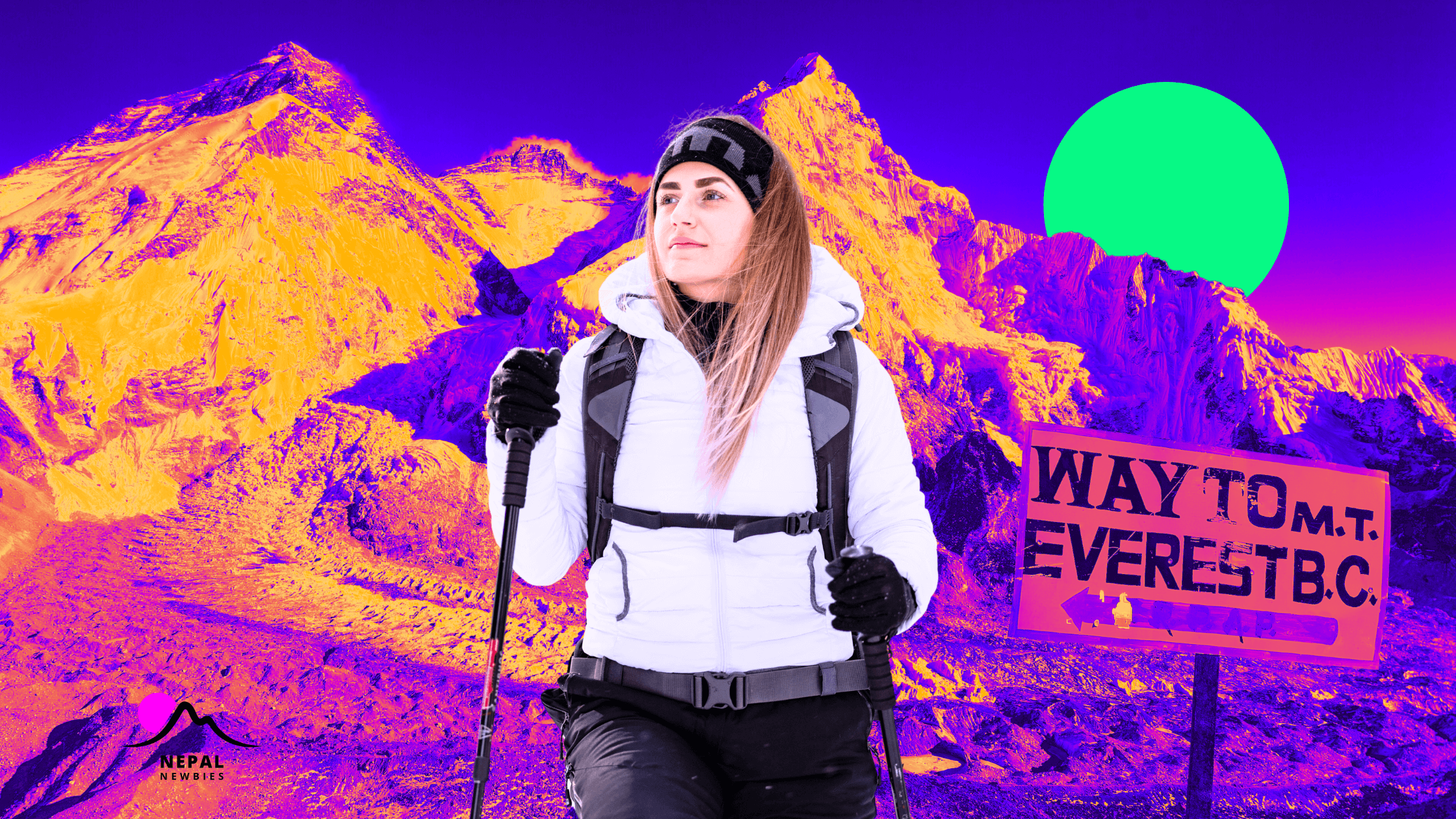
Ever thought about ticking Everest Base Camp off your bucket list? Instagram and glossy trekking brochures make it sound easy: train rigorously on the stairs, do cardio for three months, and you should be fine. Many trekking agencies describe it as doable for anyone with "excellent fitness and a sensible schedule."
I believed that too, until I dug deep into the data and experienced on the trail what happens to the human body above 3,000 meters (10,000 feet). There is a big gap between sales talk and mountain reality. Here is the honest answer.
Can a Beginner Do the Everest Base Camp Trek? The Short Answer:
⚡ Can a beginner do EBC? Yes, but for most of us it's not a good first trek. EBC needs no climbing skills, but it's 12–14 days of trekking at high altitude, up to 17,598 ft (5,364 m). Plan on 6–12 months of training (the full year if you're starting from zero), extra acclimatization days, and a shorter warm-up trek first, like Poon Hill or Mardi Himal.
Here is why I say "yes, but":
- Technically, it's a hike, not a climb. The trail is non-technical: no ropes, ice axes or climbing skills required.
- Physically and mentally, it's a relentless expedition. Long days, thin air and cold nights, for 14 days or more in a row.
- Altitude sickness is common. Reported rates of acute mountain sickness (AMS) among trekkers in Nepal range from roughly 22% to 68%, depending on where, when and how fast people ascend (Strickland & Kanaan, 2019). In a survey of 366 Everest Base Camp trekkers, 40.5% had at least one medical incident on the trek, and about half of those incidents were altitude sickness (2022 study).
My take? For most of us beginners, Everest Base Camp shouldn't be our very first multi-day trek. Unless we're exceptionally fit and ready to train like endurance athletes for a full year, ideally including some time at altitude, there are better places to start.
Not sure where you stand? Take the 6-question Readiness Test below.
Medical & safety note: This article shares my personal experience and general information, not medical advice. Altitude sickness can be life-threatening, and it can't be predicted from age or fitness alone. See your doctor or a travel-medicine clinic at least 6–8 weeks before departure, especially if you have heart, lung, blood-pressure or diabetes concerns or take regular medication.
Are you a beginner? What It Means in Himalayan Trekking
In Himalayan trekking, a beginner isn't only someone brand new to hiking. You're a beginner if you have:
- Limited or no experience with multi-day treks (hiking 6+ hours day after day).
- Zero experience hiking at high altitude, that's above 3,000 meters (10,000 feet).
- Never dealt with the unpaved, rocky and unpredictable conditions of the Himalayas.
If you're brand new to hiking altogether, that counts too of course.
So for me, I fit the beginner profile exactly when I started planning my Nepal trekking adventure, and I quickly realized there is more to Everest Base Camp than "excellent fitness." I took my first multi-day trek in 2024, to Mardi Himal Base Camp (4,500 m / 14,764 ft).
I can tell you, the higher I went, the harder it got! I haven't trekked to Everest Base Camp, which is about 860m (2,800 ft) higher, so for the medical side I rely on the CDC, UK travel-health guidance and the published research linked in this article.
💡 Can You Trek to Everest Base Camp in Your 50s or 60s? Age vs. Altitude
Being "of a certain age" myself, this was one of the first things I wanted answered: does age decide whether you make it? The research is more encouraging than you might expect, but it isn't simple.
- Younger trekkers often get altitude sickness more. A study of trekkers in the Nepali Himalaya found younger age was among the risk factors for AMS, along with female sex, higher body mass index and smoking (Wilderness & Environmental Medicine, 2014). Findings across studies aren't fully consistent (see this meta-analysis), so treat age as one factor among many, not a rule.
- Why? My theory is ego and pace. You see it on the trails: Younger hikers are more likely to walk fast and possibly faster than their bodies can acclimatize and to push through early warning signs. Researchers have also suggested that higher activity levels play a role.
- Fitness doesn't protect you from altitude sickness, at any age. UK travel-health guidance notes that being fit doesn't protect against altitude illness, and that gradual ascent with regular rest days is the key to prevention (TravelHealthPro).
- Older trekkers face different risks. Muscles recover more slowly in sub-zero teahouses, and heart, lung, blood-pressure or diabetes concerns and regular medication become more common. The CDC advises people with heart or lung disease to talk to a doctor familiar with high-altitude medicine before the trip, and notes that diabetes can be harder to manage at high elevation (CDC).
So age alone won't stop you from reaching Base Camp, and it won't guarantee you get there either. If you are medically cleared and willing to go at a steady pace ("Bistari, bistari" is Nepali for "slowly, slowly") with extra rest days built in, patience can be your secret advantage.
How Hard Is the Everest Base Camp Trek? Key Numbers
The standard route is a round trip of about 130 km (81 mi) through the Himalayas, typically over 12–14 days. You'll face steep ascents, rocky paths, glacier moraine and long, windy suspension bridges. Most itineraries also add the Kala Patthar viewpoint for the best view of Everest.
| Metric | Details |
|---|---|
| Distance (Round Trip) | About 130 km (81 mi) |
| Typical Duration | 12–14 days (18–21 days recommended for better acclimatization) |
| Start Altitude (Lukla) | 2,860 m (9,383 ft) |
| Everest Base Camp Altitude | 5,364 m (17,598 ft) |
| Kala Patthar Viewpoint Altitude | 5,545 m (18,192 ft) |
| Net Elevation Gain (Lukla to EBC) | About 2,500 m (8,200 ft) |
| Total Cumulative Elevation Gain | Roughly 8,000 m (26,200 ft) (counting every ascent & descent) |
The trail is not a steady climb. You often descend before climbing again, which is why the total climbing is so much higher than the net gain.
Nepal Trek Difficulty Levels: Where Everest Base Camp Fits
There is no single universal grading system, and trekking agencies label the same trek differently. That makes it tricky to judge whether a trek suits you, so always check the daily altitude gains in the itinerary. Here is my simplified guide, based on altitude and terrain:
| Level | What to expect | Examples (highest point) |
|---|---|---|
| Easy (Beginner Level) |
|
• Ghorepani Poon Hill Trek (3,210 m / 10,531 ft) • Langtang Valley Trek (3,870 m / 12,696 ft) • Everest View Trek (3,860 m / 12,664 ft) |
| Moderate (Intermediate Level) |
|
• Mardi Himal Base Camp (4,500 m / 14,764 ft) • Annapurna Base Camp Trek (4,130 m / 13,549 ft) |
| Strenuous (Advanced Level) |
|
• Everest Base Camp Trek (5,364 m / 17,598 ft) • Gokyo Lakes Trek with Gokyo Ri (5,357 m / 17,575 ft) • Manaslu Circuit Trek (5,160 m / 16,929 ft) • Annapurna Circuit Trek (5,416 m / 17,769 ft) • Kanchenjunga Base Camp Trek (5,143 m / 16,873 ft) |
| Challenging (Expert Level) |
|
• Everest Three Passes Trek (5,535 m / 18,159 ft) • Upper Dolpo Trek (5,151 m / 16,899 ft) • Dhaulagiri Circuit Trek (5,360 m / 17,585 ft) |
So Everest Base Camp is a strenuous, advanced-level trek. It is not a beginner trek, and that is exactly why the next section matters.
The Beginner EBC Readiness Test (6 Questions)
Important: This self-assessment is not a scientific or medical test, and it isn't formal travel or safety advice. It is a common-sense reflection framework I developed based on field observations and standard trekking guidelines. Its goal is not to give or refuse you permission. It is to help you reflect on how demanding this trek really is before you commit. When I filled this out from my own starting point before my 2024 trek, it came out as a resounding NO for Everest Base Camp. I started with Mardi Himal instead, and admitting that saved me from a potentially miserable never-again experience.
Score yourself honestly on these 6 criteria: A = 3 points, B = 1 point, C = 0 points.
1. Targeted Training Commitment
A: I can and will train 3–5 days a week for 6 months or more, including weighted hill walks, mountain hiking, stairs and leg strength.
B: I can do 1–2 days of gym or jogging, but I don't have steep hills or time for long weighted hikes.
C: I'm relying on my general fitness or a few weeks of light cardio before the trip.
2. Multi-Day Endurance Baseline
A: I've done multi-day hikes (3+ consecutive days) carrying a loaded backpack in hilly or mountainous terrain.
B: I do long day hikes on weekends, but I've never hiked multi-day.
C: I rarely hike. My fitness comes from gym sessions or flat road running.
3. Cold & Basic Comfort Tolerance
A: I'm fine sleeping in sub-zero rooms, using pit toilets, going days without a hot shower and wearing dirty gear.
B: I can handle basic camping, but I get physically drained when cold and unwashed for more than two days.
C: I need hot showers, heated rooms and good amenities to recover.
4. High Altitude Awareness
A: I've spent time or hiked above 3,000 m (10,000 ft), and I know how my body reacts to thinner air.
B: I've been to high altitude by cable car or ski resort, but never hiked there for long hours or days.
C: I've never been above 2,500 m (8,200 ft).
5. Itinerary Time & Flexibility
A: I can take an 18–21 day trip, giving me 3–4 extra acclimatization and buffer days.
B: I'm locked into a standard 14-day itinerary with minimal rest days.
C: I'm looking at a budget or express 10–12 day trek.
6. Mental Pacing & Ego Control
A: I'm comfortable hiking extremely slowly ("Bistari, bistari") and have no problem turning around if I feel unwell.
B: I tend to push through so I don't slow others down, but I will stop if symptoms get severe.
C: I'm naturally competitive and always try to keep up with the front of the group.
What Your Score Means
- 15–18 points: High readiness. You have the right mindset, realistic expectations and the willingness to prepare. With a disciplined training block, Everest Base Camp is a solid challenge for you.
- 8–14 points: Level up first. Attempting Everest Base Camp right now is a gamble. Commit to hill/mountain training, extend your itinerary to 18+ days, and do a 4-day warm-up trek in Nepal first, such as Ghorepani Poon Hill.
- 0–7 points: Not yet. Don't start with Everest Base Camp. Without targeted training, multi-day experience or altitude awareness, you are far more likely to struggle, turn back or need help. Start with gentler treks like Ghorepani Poon Hill (3,210 m / 10,531 ft) or Mardi Himal Base Camp (4,500 m / 14,764 ft).
A low score isn't a "no forever." It's a "not yet."
Prepare for Your Nepal Trek the Easy Way –
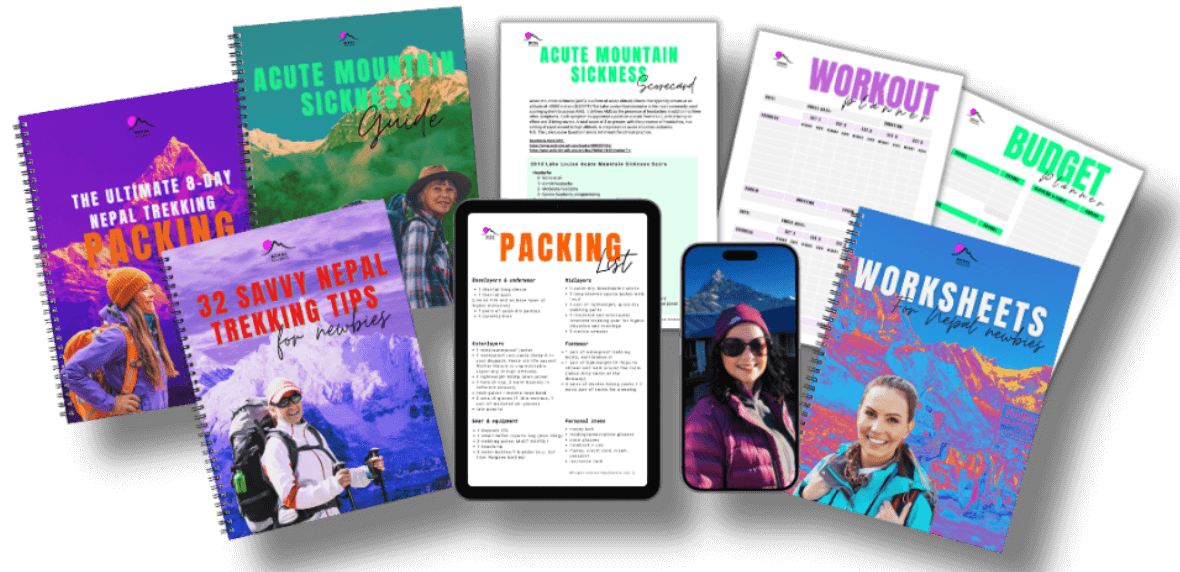
Get the Ultimate NEPAL Starter Kit.
NEW: Grab my complete Starter Kit packed with gear lists, handy guides, worksheets, and insider tips for trekking smart in Nepal!

Why Everest Base Camp Is Hard for Beginners: 5 Challenges
1. Varied terrain
Steep ascents demand strength, pacing and stamina. Rocky paths need constant attention to your footing. A misstep can mean a slip or an injury. Wet or loose-gravel descents can be intimidating, and fear of losing control adds mental strain.
2. Long days, day after day
The standard itinerary is 12–14 days of walking, often 6 or more hours at a time. If you are not used to it, muscle soreness, blisters and fatigue pile up, and burnout can spoil the experience. This is why multi-day experience matters more than a strong single-day hike.
3. Altitude
Altitude is what beginners underestimate most. At 3,050 m (10,000 ft), the oxygen pressure in the air you breathe is only about 69% of what it is at sea level (CDC Yellow Book).
Acute mountain sickness feels like a bad hangover: a headache plus at least one of loss of appetite, dizziness, fatigue, nausea or vomiting. Beginners often don't recognize what they are dealing with, or brush it off. Even on standard acclimatization schedules, the CDC notes that altitude illness can approach 30% prevalence at higher elevations, and that adding extra days makes the trek safer and more enjoyable.
| Altitude zone | Range |
|---|---|
| High altitude | 1,500–3,500 m (4,921–11,483 ft) |
| Very high altitude | 3,500–5,500 m (11,483–18,045 ft) |
| Extreme altitude | above 5,500 m (18,045 ft) |
So much of the Everest Base Camp trek is actually in the very high zone, and the Kala Patthar viewpoint (5,545 m) briefly enters extreme altitude!
PRO TIP: When to descend immediately? Go down right away, and get medical help, if you or someone in your group has:
- confusion, unusual behavior or loss of coordination (trouble walking in a straight line),
- breathlessness at rest or when lying flat,
- a persistent cough, chest tightness or pink, frothy phlegm,
- a headache that keeps getting worse, with vomiting, despite rest.
These can be signs of high-altitude cerebral or pulmonary edema, which are life-threatening. Never go higher while you have symptoms, and never leave someone with symptoms alone. Ask your doctor about preventive medication (for example acetazolamide) before you go, and don't self-prescribe. Sources: CDC and TravelHealthPro (UK).
4. Unpredictable weather
Himalayan weather can change within a single day, and the trail passes through several climate zones.
- Cold: even in peak season, nights can drop well below freezing above 4,000 m (13,000 ft). Without proper layers, hypothermia is a real risk.
- Wind: at higher elevations it can be intense, making the trek harder and raising the risk of frostbite.
- Rain and snow: during the monsoon (June–September) heavy rain makes trails slippery, and snowfall in colder months can make paths dangerous.
Beginners are more likely to struggle here: wet or cold gear drains your energy, sweating on the climb and chilling when you stop is easy to get wrong, and it's easy to underestimate how much you need to drink and eat. Packing right helps a lot.
5. The mental side
Being away from familiar comforts for weeks, sometimes in remote places, affects your mood, and a body under stress makes it worse. Here is how physical discomfort turns into mental strain:
- Breathlessness and fatigue: every step takes more effort in thin air, which can feel like doubt or inadequacy.
- Soreness: sore muscles, joints and blisters bring irritability and the urge to give up.
- Cold and wet: feeling chilled for hours is hard on your motivation.
- Poor sleep: altitude disturbs sleep, so fatigue compounds day after day.
- Altitude sickness: headaches and nausea, plus the fear of getting worse, create pressure to "push through."
In a group, peer pressure to keep up makes all of this harder. This is why "ego control" is one of the six questions in the test.
10 Tips for Beginners Attempting the Everest Base Camp Trek
- Take 3 weeks instead of 2. Extra days allow better acclimatization, more rest and a more enjoyable pace.
- Avoid peer pressure. Trek with a guide or a small group at your own level, so you never feel forced to keep up.
- Make acclimatization a priority. Above about 2,400 m (8,000 ft), climb gradually. MedlinePlus advises a day or two of rest for every 600 m (2,000 ft) you climb above that height. My own rule of thumb: keep the rise in sleeping altitude to 300–500 m (1,000–1,600 ft) per day, and add a night at the same altitude if you go beyond that. Some itineraries, and even well-meaning guides, may push you higher faster. It's your body, so speak up and adjust.
- Do a less demanding trek first. Mardi Himal Base camp Trek or Poon Hill let you build stamina and learn how your body responds to altitude.
- Level up your hiking experience. Multi-day hikes and hill terrain prepare you far better than gym cardio alone.
- Get quality footwear. Wear your hiking boots in well before the trip, or expect blisters, foot pain and back pain.
- Listen to your body. If you feel unwell, don't push through. Rest, hydrate and acclimatize more if needed.
- Be prepared for the weather. Bring waterproofs, warm layers, a sun hat and sunscreen. Bring your own warm sleeping bag for the cold nights.
- Get travel insurance with evacuation cover. Check that helicopter evacuation is included and that the policy covers the maximum altitude of your trek, since many standard policies stop well below Base Camp height.
- Take it slow and enjoy the journey. It's not a race, even if other trekkers make it feel like one. Bistari, bistari.
Frequently Asked Questions
Can a complete beginner do the Everest Base Camp trek?
Yes, but I wouldn't recommend it as a first trek. Base Camp is non-technical, so you don't need climbing skills, but it's 12–14 days at "very high altitude", and the Kala Patthar viewpoint (5,545 m / 18,192 ft) briefly reaches "extreme altitude". Build multi-day and altitude experience first with a trek like Mardi Himal Base camp, train for 6–12 months, and allow extra acclimatization days.
How fit do you need to be for Everest Base Camp?
You need solid cardiovascular fitness and leg strength, plus the ability to walk 6 or more hours a day, day after day, on uneven terrain. But fitness alone doesn't protect you from altitude sickness, so your pace and itinerary matter just as much as your training.
Can you do Everest Base Camp in your 50s or 60s?
Can you do Everest Base Camp in your 50s or 60s?
Many people do. Age alone isn't the deciding factor. Get medical clearance from your doctor first, allow at least 18–21 days for extra acclimatization, and go at a steady, patient pace rather than trying to keep up with younger or faster trekkers.
How long should a beginner train before attempting EBC?
How long should a beginner train before attempting EBC?
I'm not a fitness trainer, so take this as general guidance rather than a personal training plan — check with your doctor before starting, especially if you have any health conditions. Most sources suggest starting 6–12 months ahead for beginners, combining cardio with leg and core strength, and adding hill walks and loaded-pack hikes as your trek gets closer. In my own experience, a multi-day warm-up trek at altitude, like Mardi Himal, was the best way to test how my body actually responds — better than any amount of gym training alone.
So, Can a Beginner Do the Everest Base Camp Trek? My Verdict
Yes, but I would suggest not as your first trek, and not without the proper preparation. Give yourself 6–12 months of training, at least one multi-day trek at altitude, and an 18–21 day itinerary with extra acclimatization days. Be honest about your readiness score, and be willing to slow down or turn around if your body tells you to.
If you are just starting out with Nepal trekking, I believe that beginners do best by building experience step by step. That's what I did. You learn so much on the trail, about hiking, the techniques, your body and your mind.
Remember, every experienced hiker started as a beginner. The EBC trek isn't only about reaching Base Camp. It's about the scenery, the local culture and the personal growth along the way.
Sources & Further Reading
- CDC Yellow Book: High-Altitude Travel and Altitude Illness
- CDC Travelers' Health: Travel to High Altitudes
- TravelHealthPro (UK): Altitude Illness
- MedlinePlus: Acute Mountain Sickness
- Strickland & Kanaan (2019), Sources for Altitude Illness Information for Trekkers in the Himalayas, Wilderness & Environmental Medicine
- Risk determinants of acute mountain sickness in trekkers in the Nepali Himalaya: a 24-year follow-up (2014)
- Companion Rescue and Risk Management of Trekkers on the Everest Trek, Solo Khumbu Region, Nepal (2022)
- Association between acute mountain sickness and age: a meta-analysis (Military Medical Research, 2018)
- Luks AM, et al. Wilderness Medical Society clinical practice guidelines for the prevention, diagnosis, and treatment of acute altitude illness: 2024 update. Wilderness & Environmental Medicine, 2024.
About Sandra
Sandra is the founder of Nepalnewbies.com. In her fifties, and coming from the flat Netherlands with no multi-day mountain experience, she trekked to Mardi Himal Base Camp (4,500 m) in 2024 and now shares what she learned so other beginners can prepare realistically. Read more about me.

YOUR TURN: Any thoughts, advice, experiences, questions? Share in the comments.
Leave a Reply
PREPARE FOR YOUR NEPAL TREK THE SMART WAY!
Everything I wish I'd had before my first trek: checklists, worksheets and honest tips. Free!

Hey there, I'm Sandra!
Life coach, mountain lover and proud Nepal newbie. I did my first trek in Nepal in my fifties, and it changed everything. Nothing grounds you like standing among those Himalayan giants.
On the trail, I learned the hard way that it's as much a mental game as a physical one. So I started Nepalnewbies.com to give beginners like us the honest advice I wish I'd had. No sugar-coating.
👉 READ MY STORY
Popular articles
⚡The real stuff about trekking in Nepal, no sugar-coating.
What I found out, no sugar-coating, about what 17,598 ft (5,364 m) asks of you.
I made it to base camp, but my prep wasn't even close. Learn from my mistakes.

Here's what using a toilet is really like on a trek, and 10 tips to make it a lot less awkward.
NEW: THE NEPAL STARTER KIT.
Grab My Nepal Starter Kit.

PREPARE FOR YOUR NEPAL TREK THE SMART WAY! Everything I wish I'd had before my first trek: checklists, worksheets and honest tips. Free!
Copyright ©Nepalnewbies.com All Rights Reserved.
The Nepal trekking blog for beginners who want the real story. First-hand experience from a fifty-something beginner, honest tips and practical guides for your first trek in Nepal. Squat toilets included. No sugar-coating.
9 replies to "Can a Beginner Do Everest Base Camp? An Honest Answer."
[…] Can a beginner do Everest Base Camp Trek? […]
[…] Can a beginner do Everest Base Camp Trek? […]
[…] Can a beginner do Everest Base Camp Trek? […]
[…] Can a beginner do Everest Base Camp Trek? – Nepalnewbies September 21, 2026 […]
[…] Can a beginner do the Everest Base Camp Trek? […]
[…] Can a Beginner Do Everest Base Camp? An Honest Answer. […]
[…] Can a beginner do Everest Base Camp Trek? – Nepalnewbies September 16, 2026 […]
[…] Can a Beginner Do Everest Base Camp? An Honest Answer. […]
[…] Can a Beginner Do Everest Base Camp? An Honest Answer. […]