
Published October, 2026 in TREKKING.
Too old to trek Nepal? What I learned trekking in my fifties.

By Sandra · Founder of Nepalnewbies.com, first-time Himalayan trekker (Mardi Himal Base Camp, 2024)

"Am I too old for this?"
If that question pops up right after watching yet another Everest Base Camp video starring a 32-year-old with calves the size of bowling balls—welcome to the club. I'm a card-carrying member. Seeing Everest with my own eyes and standing in front of The Rock is still at the absolute top of my bucket list. But the doubt creeps in: Can I actually do this? Am I too old?
Spoiler: No, age alone doesn't rule us out. Plot twist: Trekking in Nepal after 50 as a beginner asks a hell of a lot from our body—and even more from our head.
In 2024, I completed my first multi-day Himalayan trek: Mardi Himal Base Camp at 14,764 ft (4,500 m). I was in my fifties, came straight from the Netherlands (where our highest "mountain" is basically a speed bump), and had absolute zero high-altitude experience.
So I did what any slightly nervous beginner does: I dug into the research. A lot of it. And then I hit the trail to find out what all those facts and figures actually feel like in real life. No sales pitches. No generic pep talks. Just what the science says about altitude, terrain, and taking on the Himalayas as a fifty-something newbie—and what that really means for the rest of us.
Medical & safety note: This article shares research and my personal experience, not medical advice. Altitude sickness can be life-threatening, and it can't be predicted from age or fitness alone. See your doctor or a travel-medicine clinic at least 6–8 weeks before departure, especially if you have heart, lung, blood pressure or diabetes concerns or take regular medication.
Is there an age limit for trekking in Nepal?
Nope. Nobody at the permit office asks for your birth certificate, and there’s no bouncer at the trailhead checking IDs 😉. So on paper? Zero limits.
And here's a fact: we aren't even the odd ones out. A study of 350 trekkers on the Everest trail found that ages ranged all the way from 18 to 76 (Haunolder et al., 2022). Proof that the trail doesn't care about your birth year.
So the real question isn't if we can go. It’s how we go—with the right prep, the right trek, and the right pace.

Altitude After 50: What the Research Says
Good news first—because we deserve it: getting older doesn't make us more prone to altitude sickness. Meaning: age doesn't trigger AMS. A meta-analysis examining trekkers aged 10 to 76 found no direct link between age and Acute Mountain Sickness (AMS) (Wu et al., 2018). That is good news.
The expert verdict: A systematic review by researchers in Kathmandu and Oxford analyzed 26 studies: 12 showed less AMS in older trekkers, 11 found no link at all, and only 3 showed an increase. Their verdict? Older age is absolutely no reason to stay away from high altitude.
Our heart and lungs can take it: A landmark French study showed that in healthy, active individuals, heart and lung response to thin air remains robust up to roughly age 80 (Richalet et al., 2015). The fine print? No underlying cardiac or respiratory conditions, and a fitness level matched to the route.
So far, so good. Now let’s talk about the practical reality once we actually hit the trail.
PRO TIP: A quick check: low mood and irritability can also come from exhaustion, dehydration or the altitude itself. If you also have a headache, nausea or dizziness, tell your guide. That's maybe not homesickness, and it shouldn't be ignored.
Prepare for Your Nepal Trek the Easy Way –
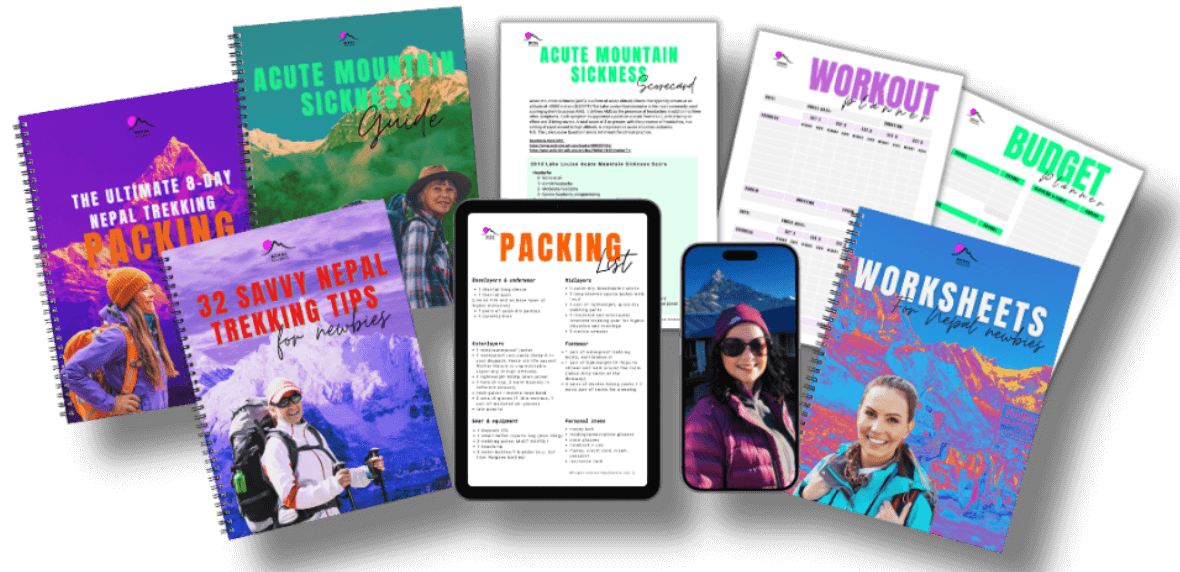
Get the Ultimate NEPAL Starter Kit.
NEW: Grab my complete Starter Kit packed with gear lists, handy guides, worksheets, and insider tips for trekking smart in Nepal!
9 ways to cope with homesickness on your trek
1. Name it
Just saying "I'm homesick" out loud, or in your head, takes some of the power out of it. You're not failing. You're having a feeling. Feelings come and go, especially up there.
2. Check your basics first
Before you decide your whole trip is a mistake, ask yourself: am I hungry? Cold? Tired? Dehydrated? More often than not, homesickness gets a lot smaller after a hot meal, a warm layer and a good night's sleep. Deal with your body first, then your mind.
3. Remember it comes in waves
Homesickness rarely lasts the whole trek. It comes, it peaks and it passes, often within hours. Tomorrow morning, with the sun on the mountains, the world usually looks very different. Tell yourself: this is a wave, not the whole ocean.
4. Plan your contact with home
Instead of checking for signal every hour, agree on a rhythm before you leave, for example a short message every evening when there's Wi-Fi. Let your loved ones know you might be offline for a day or two, and that a video call might not always work. That way, silence doesn't turn into worry on either side.
PRO TIP: Give your family the details of your trekking company, and your itinerary, like we did. Knowing that they could reach someone in Kathmandu if needed gave our families peace of mind, and that made it easier for us to relax too.

5. Bring a little bit of home
Small things can make a big difference. I had a photo of my family as my phone's screensaver, so every time I checked for signal, there they were. Your favorite tea bags, a scarf that smells like home, or a playlist or audiobook downloaded before you leave can do the same. Small reminders that home is still there, waiting for you.
6. Create a small evening ritual
Evenings are the hardest. A little routine helps: write in your journal, read a few pages, listen to a meditation, or write down three things that made you smile that day. It gives your mind something familiar to hold on to.
And if, like me, you wish your loved ones could see what you're seeing: write it down for them. Describe the view, the people, the moment. You can share it when you're back, and in the meantime it feels a little like they're with you.
7. Talk about it
With your travel companion, your guide, or other trekkers in the teahouse dining room. You'll be surprised how many people feel the same. And guides have seen it all before. A good guide knows how to lift your spirits, even if it's just with a joke or an extra cup of tea.
8. Shift your focus to the next small goal
On a hard day, don't think about the whole trek. Think about the next viewpoint, the next tea stop, the next teahouse. Small goals feel doable. The whole mountain doesn't.
9. Remember why you came
Somewhere in your bag or your phone, keep a note of why you wanted to do this trek in the first place. Was it a dream you'd had for years? Proving to yourself that you still can? Read it when the magic wears off. It's amazing how quickly that brings you back.
When homesickness doesn't go away
For most trekkers, homesickness comes and goes. But sometimes it sticks, and the trek becomes something to get through rather than enjoy. If that happens, it's okay. Talk to your guide about your options: a shorter route, an extra rest day, or even turning back. Ending a trek early isn't failing. Knowing your limits is part of being a good trekker.
And if you've had a hard time on the trail, or feel lost after coming home, you're not alone in that either.
What I learned from being homesick in the Himalayas
Being homesick surprised me. I'd always thought of myself as someone who travels easily. But Nepal asked more of me, physically and emotionally, than any trip before.
Looking back, I don't see my homesickness as purely a beginner's thing. Standing in front of those mountains, out of breath and far from home, I realized how much I love the people waiting for me. My daughter, my family, even my little dog. That's not a bad thing to be reminded of.
Homesickness isn't a sign that you don't belong on the trail. It's a sign of how much you love what you left behind. And coming home with that OMG, I freaking did it! feeling is all the sweeter for it.
PRO TIP: Bring two professionals trekking poles, they're life savers! I bought mine in Kathmandu, but didn’t check them carefully in the store—and they were actually broken right from the start, which was my own bad. So lesson learned: always check your gear before you leave the shop!
Frequently asked questions
Is it normal to feel homesick on a trek in Nepal?
Absolutely. Long days, cold nights, unfamiliar food, patchy connection and little privacy make homesickness common, even for experienced travelers who normally never get homesick. It usually comes in waves and passes within hours or days.
Why do I feel homesick when I'm only away for a relatively short time?
On a trek, it's not about how long you're away. Physical exhaustion, cold, bad sleep, a completely unfamiliar environment and hours of time to think can make you miss home much sooner than on a normal holiday.
How can I stay in touch with home while trekking in Nepal?
Many teahouses offer Wi-Fi, often for a small fee, but the connection is often too weak for video calls and may be unavailable higher up. Agree on a check-in rhythm with your family before you leave, and let them know you may be offline for a day or two. Also, buy a local sim card, that'll work for quick whatsapp messages.
Can homesickness be confused with altitude sickness?
Low mood and irritability can come from exhaustion or altitude as well. If you also have a headache, nausea, dizziness or unusual tiredness, tell your guide straight away, as these can be early signs of altitude sickness.
What should I do if homesickness ruins my trek?
Talk to your guide about your options, such as an extra rest day, a shorter route or turning back. Ending early isn't failing. Your wellbeing matters more than finishing.
How can I prepare for homesickness before my trek?
Plan how and when you'll contact home, bring a few small comforts from home, like a family photo as your phone's screensaver, download music or audiobooks, your favorite scent and write down why this trek matters to you. Knowing homesickness might come also makes it easier to handle when it does.
Ready to prepare for the mental side too?
Your legs and lungs will carry you up the mountain, but your mind decides how you'll experience it. See more tips on how to prep mentally: Preparing for your first trek in Nepal.
Have you ever been homesick on a trip? Tell me in the comments. You're definitely not the only one!
PRO TIP: buy a local Ncell SIM card at the airport. Go to the quiet stall just behind customs—no lines, friendly service, and it takes all of five minutes. For 1000 rupees, we had data throughout most of the trek. We were even able to video call our families from 4,200 meters. That connection to home was incredibly grounding.
PREPARE FOR YOUR NEPAL TREK THE SMART WAY!
Everything I wish I'd had before my first trek: checklists, worksheets and honest tips. Free!

Hey there, I'm Sandra!
Life coach, mountain lover and proud Nepal newbie. I did my first trek in Nepal in my fifties, and it changed everything. Nothing grounds you like standing among those Himalayan giants.
On the trail, I learned the hard way that it's as much a mental game as a physical one. So I started Nepalnewbies.com to give beginners like us the honest advice I wish I'd had. No sugar-coating.
👉 READ MY STORY
Popular posts
What I found out, no sugar-coating, about what 17,598 ft (5,364 m) asks of you.
I made it to base camp, but my prep wasn't even close. Learn from my mistakes.

Here's what using a toilet is really like on a trek, and 10 tips to make it a lot less awkward.
NEW: THE NEPAL STARTER KIT.
YOUR TURN: Any thoughts, advice, experiences, questions? Share in the comments.
Grab My Nepal Starter Kit.

PREPARE FOR YOUR NEPAL TREK THE SMART WAY! Everything I wish I'd had before my first trek: checklists, worksheets and honest tips. Free!
Copyright ©Nepalnewbies.com All Rights Reserved.
The Nepal trekking blog for beginners who want the real story. First-hand experience from a fifty-something beginner, honest tips and practical guides for your first trek in Nepal. Squat toilets included. No sugar-coating.
Copyright © YourCompany. All Rights Reserved